
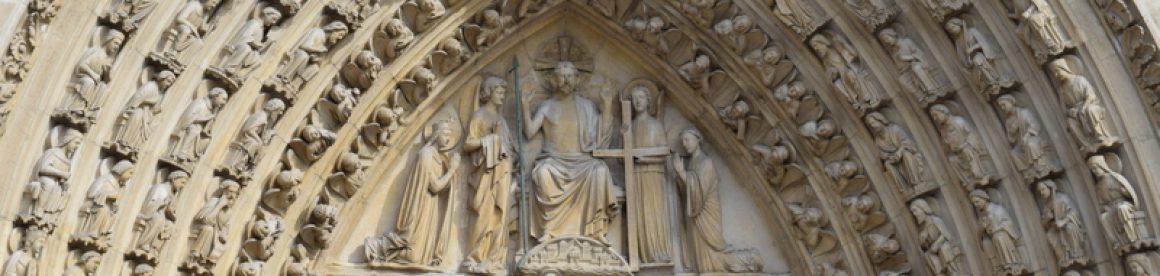

Why do we gather, year after year, to retell the same story? We all know how this ends. Jesus was executed on a cross, he was clearly dead and then he wasn’t. We all know what this means, right? It means that if we believe in Jesus then we will also get to be alive after we die and until that happens, we just need to limp along through life and do our best to be good people. The end.
Today the cross is seen as a symbol of forgiveness, redemption, resurrection and even comfort and our adoration of the cross is not misplaced, but I fear that we have lost the most important part of its meaning. In the first century it was ultimate symbol of a painful death. It was a very painful tool of execution, yet we don’t view it that way, which is unfortunate because as Bonhoeffer said “When Christ calls a man, he calls him to come and die.” Which is not a very inviting message, yet it’s true. It is true because important things have a cost, love requires us to sacrifice a part of ourselves for the benefit of another person; taking the time we need to regenerate after a long day requires that we put aside the to-do list even if it means something important has to wait; living in a committed relationship or raising children requires that we give up some of our desires and habits; and living a God centered life requires us to give up parts of ourselves because the love and joy of Easter, of resurrection, of new life requires that we die, but not just any death, not a peaceful in our sleep death after a lifetime of good living kind of death. It requires a hard death, a death that will involve some pain and fear and even anger. A death that requires us to willingly suffer the very real pain and raw emotions we know will come when we give ourselves over to it. The kind of death we would experience if we were hung from a cross, the kind of death Jesus had.
The reason we need to tell the same story every year is because we very quickly forget that the life, death, and resurrection of Jesus is not only about the simplified cycle of passive belief in God so many people think it is. It isn’t only about getting to go to heaven, which isn’t even what people think it is anyway. It isn’t only about being resurrected after we die. It is about having a new life now. If the life of Jesus was about life after actual death, then why would he have spent three years healing the sick, and telling parables that are so abstract and mystical that we learn something new about ourselves every time we hear them?
Reducing our faith to the belief that Jesus died for our sins so that we can go to heaven is not wrong, but it also isn’t the whole truth. Jesus invites us to die to this world every day with the knowledge that new life is not only possible, but guaranteed. The Gospels are filled with examples of how Jesus helped people receive new life. He helped countless people walk, and see, and stand, and speak, he helped people feel whole and if that is not new life then I don’t know what is; but in order for these miracles to happen a very specific things had to occur, they had to be willing to give up the life that they knew before they could have a new life.
New life can look like many things, we all know it can literally mean life after death, that is the obvious definition, but also not likely what Bonhoeffer was referring to when he spoke of Christ’s invitation to death. The invitation to death is an invitation to have a change of heart, it is an invitation to change how we view and approach the world. It is an invitation to die to selfishness, to approach every person with the assumption that their intentions are good and trust that they too desire peace; to approach every situation with the assumption that a positive outcome is possible, most especially when it feels like the intentions behind the situation are rooted in selfishness and even evil. This is not an easy ask, allowing yourself to trust other people, to assume that their intentions are good even when their actions indicate otherwise; to trust that the systems we have made to facilitate our interactions, while flawed, are infused with God’s love and that the people who work within those systems want to do what is best to be good people even if the work they’re doing appears contrary to what we would call good. Even when we don’t believe that God is at work in other people, we have to trust that they are, we have to trust that the Holy Spirit is at work in everyone and by loving them, and trusting them, and praying for them, they too will choose death and allow the Holy Spirit to take control.
The miracle of Easter is not just that we receive new life after physical death, it is that we can receive new life now, we can be free from the control of the fear, and anxiety, and sadness that grips us; but to be free of these things we must first choose to face the cause of them because unless we do, death is not possible and neither is new life. Facing the things that cause us anxiety and fear and sadness is painful, but from pain comes new life.
We retell the same story, year after year, not to remind us that we will receive new life after death, but to remind us of the possibility and the reality of receiving new life now; but it is only possible if we first allow our need for control to die begin assuming that good exists in all people because it does. If we do not believe that people can change, if we do not believe that we can change, then it is a sign that we do not trust God; that we do not believe that new life possible and we are not ready or willing to turn ourselves over to death. Accepting Christ’s invitation to death requires that we do the spiritual work that is necessary to become better people, it requires that we engage with scripture, learn from it, take it to heart, and allow it to guide our thinking and decision making to the point that seeing the potential for good in people and in situations becomes second nature, not because every person is a good person, but because everyone has the capability to be a good person if given the chance and we give them that chance when we believe they are capable and trust that they will not betray us. Sometimes this means that we will be hurt, sometimes it means that events will unfold in unhelpful or painful ways, but that doesn’t matter. It doesn’t matter because accepting death and new life is not about living a perfectly peaceful life, it is about living a different life, a life that is countercultural, a life that puts the needs of others, telling the truth, and trusting both God and humanity ahead of what we think is best. Jesus often put the needs of the people he ministered to ahead of himself, he always told the truth, and he most certainly trusted God and humanity. He trusted that God would not abandon him and he trusted that humanity has the capability to follow his lead, accept death, and in doing so help God restore creation to its intended purpose. Amen.
 Learning by Fire!